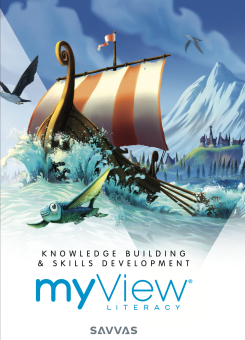
myView Literacy
Note on review tool versions
See the top of the page to confirm the review tool version used to create this report.
- Our current review tool version is 2.0. Learn more
- Reports conducted using earlier review tools (v1.0 and v1.5) contain valuable insights but may not fully align with our current instructional priorities. Read our guide to using earlier reports and review tools
Loading navigation...
Report Overview
Ratings Snapshot
| Gateway | K-2 | 3-5 |
|---|---|---|
| Gateway 1 | ||
| Kindergarten | Meets Expectations | Not Claimed |
| First Grade | Meets Expectations | Not Claimed |
| Second Grade | Meets Expectations | Not Claimed |
| Third Grade | Not Claimed | Meets Expectations |
| Fourth Grade | Not Claimed | Meets Expectations |
| Fifth Grade | Not Claimed | Meets Expectations |
| Gateway 2 | Meets Expectations | Meets Expectations |
| Gateway 3 | Meets Expectations | Meets Expectations |
ELA K-2 Overview
The myView program meets expectations for Grades K–2 by delivering explicit, research-based instruction that systematically develops foundational reading skills, comprehension, and student engagement. In Gateway 1, the materials provide a clear, coherent scope and sequence that supports the development of alphabet knowledge, phonemic awareness, phonics, word recognition, word analysis, and fluency. Instruction is anchored in consistent teacher modeling, structured routines, corrective feedback, and varied practice opportunities such as decoding, encoding, multisensory tasks, and fluency work. Assessments are embedded throughout to monitor progress and inform instruction. While Kindergarten materials demonstrate strong foundational support, they include limited corrective guidance and cumulative assessment for letter formation.
In Gateway 2, myView also meets expectations and offers a rich variety of literary and informational texts that are appropriately complex and thematically connected to build knowledge across content areas. Text complexity is supported with teacher think-alouds, vocabulary scaffolds, and comprehension checks. Students engage in structured reading and writing tasks, vocabulary routines, and inquiry-based projects that encourage exploration across disciplines like science and social studies. However, there is some inconsistency in how well writing and language instruction are integrated with reading content, and support for developing speaking and listening skills varies across lessons. Although myView provides a structured instructional pathway, the volume of supplemental materials, combined with limited guidance on how to integrate them, could make it difficult for teachers to distinguish between essential and optional content, potentially reducing the effectiveness of the core program.
Gateway 3 also meets expectations, as the program offers strong supports for both teachers and students. Teachers have access to detailed planning tools, digital resources, and research-based guidance through the Savvas Realize platform. The curriculum includes structured interventions for struggling students, small-group instruction, and enrichment options for advanced learners. The materials are accessible and engaging, with consistent formatting and student-friendly visuals. Although support for regrouping based on assessment data and accommodations beyond digital features is limited, myView succeeds in promoting equitable access to grade-level content and helping students build foundational literacy skills effectively in the early grades.
Gateway Ratings Summary
Kindergarten to 2nd Grade
Science of Reading Snapshot
| Skill | K-2 |
|---|---|
Phonemic Awareness Non-negotiable | |
Phonics Non-negotiable | |
Fluency Non-negotiable | |
Vocabulary | |
Comprehension |
Additional Elements
| Skill | K-2 |
|---|---|
Text Quality and Complexity | |
Foundational Skills | |
Building Knowledge | |
Teacher Supports | |
Student Supports | |
Instructional Pathway & Implementation Schedules |
ELA 3-5 Overview
The myView program meets expectations for Grades 3–5 by providing a comprehensive and systematic literacy curriculum that supports advanced foundational skills, deep comprehension, and strong teacher and student supports. In Gateway 1, the materials emphasize advanced word-reading strategies such as multisyllabic decoding, morphology, and spelling, all integrated within connected reading and writing tasks. Instruction is explicit and supported by consistent modeling, guided practice, scaffolded routines, and embedded assessment. Students have regular opportunities to decode and encode multisyllabic words, analyze word parts, and develop fluency through varied texts and repeated readings. The scope and sequence reflect a logical, research-based progression that fosters fluent, meaningful reading development.
Gateway 2 also meets expectations with materials that provide a balanced mix of high-quality literary and informational texts designed to build knowledge through essential questions and cohesive themes. These texts span diverse genres and include text complexity analyses and instructional scaffolds to support student understanding. Students engage in comprehension tasks, text-based writing, vocabulary instruction, and inquiry-based projects that extend across content areas. However, while writing instruction includes both on-demand and process writing, there are inconsistencies in how well sentence-level work connects to core texts, and teacher guidance for speaking and listening is uneven. Although myView provides a structured instructional pathway, the volume of supplemental materials, combined with limited guidance on how to integrate them, could make it difficult for teachers to distinguish between essential and optional content, potentially reducing the effectiveness of the core program.
In Gateway 3, myView meets expectations and offers robust implementation support for teachers and meaningful engagement opportunities for students. Teachers benefit from instructional guides, digital tools, professional learning modules, and lesson planning resources. The materials support student needs through small-group instruction, challenge tasks, and multiple modalities for demonstrating understanding. Visual design is consistent across print and digital platforms, and tools such as the Reading Routines Companion and intervention guides help address a range of learner needs. Although supports for regrouping based on assessment data and accommodations are limited, the overall design ensures usability, accessibility, and flexibility. Altogether, myView provides a structured, engaging learning experience that prepares students in Grades 3–5 for fluent reading and academic success across disciplines.
Gateway Ratings Summary
3rd to 5th Grade
Science of Reading Snapshot
| Skill | 3-5 |
|---|---|
Phonemic Awareness Non-negotiable | |
Phonics Non-negotiable | |
Fluency Non-negotiable | |
Vocabulary | |
Comprehension |
Additional Elements
| Skill | 3-5 |
|---|---|
Text Quality and Complexity | |
Foundational Skills | |
Building Knowledge | |
Teacher Supports | |
Student Supports | |
Instructional Pathway & Implementation Schedules |